What do watch battery codes mean? (CR, SR, LR explained)
The letters tell you the chemistry, the numbers tell you the size. Getting the chemistry right matters as much as the size: the wrong type can mean a dim display, a short life, or a leak inside a watch you care about.
CR — lithium, 3 volts. The standard for most digital watches. The numbers encode dimensions: CR2016 is 20mm across and 1.6mm thick, CR2025 is 20mm and 2.5mm, CR1616 is 16mm and 1.6mm. Long shelf life, very rarely leaks.
SR — silver oxide, 1.55 volts. Common in analog quartz and ana-digi watches (the Casio AD-500 Yacht Timer runs on these, as do many Seikos). Codes like SR626SW look cryptic but follow the same logic: 6.8mm diameter, 2.6mm height. The suffix matters — SW means low-drain (watches without lights or alarms), W means high-drain.
LR — alkaline, 1.5 volts. The same sizes as SR but cheaper chemistry. An LR41 fits anywhere an SR41 fits, and vintage watches like the 1976 Casio 31QR-20 were designed in the LR era. The trade-off: alkaline cells are the ones that leak, and leaks kill vintage modules. For a watch you wear daily, LR is fine if you change it on time; for one that sits in storage, silver oxide is the safer chemistry where it fits.
Cross-reference numbers (392, 384, AG3) are just other naming systems for the same cells — a quick search of "[code] equivalent" sorts it out.
If you're not sure what your watch takes, check its model page in our database — battery type is the first thing we record.
Need to identify a specific model's cell fast? Use the battery finder.
NEVER FIND A DEAD WATCH IN A DRAWER AGAIN
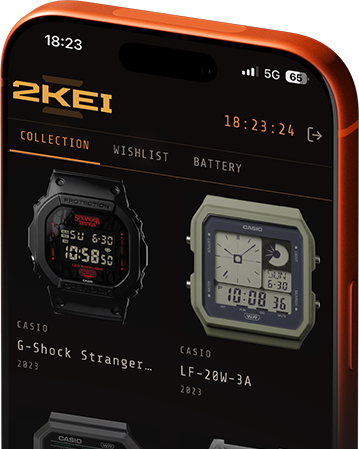
2kei tracks every battery and reminds you before it dies.
→ START TRACKING