How can I tell what year my Casio was made?
Unlike Seiko, Casio didn't stamp a serial-number date code on most watches — so dating one is detective work with converging clues rather than a lookup. Here's the toolkit, in order of usefulness.
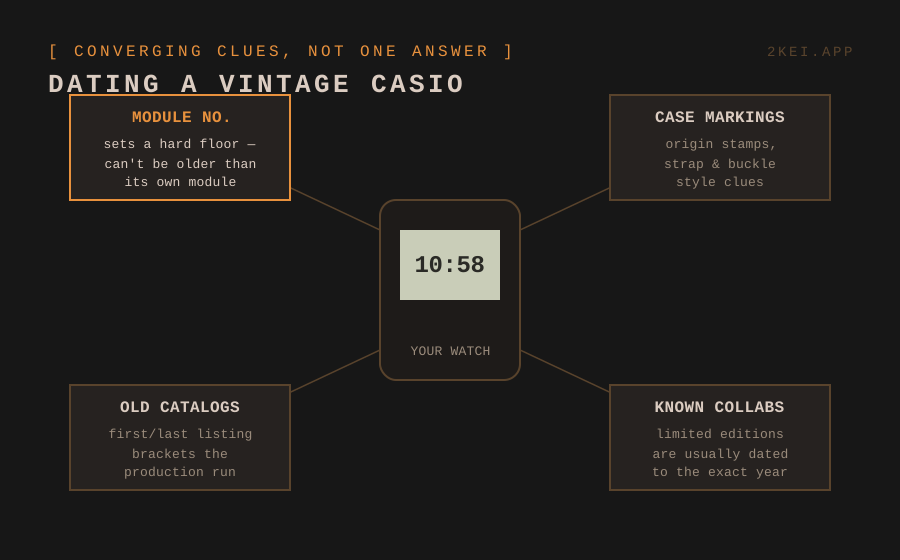
The module number sets the window. Every module has an introduction year, documented in collector databases and old catalogs. A watch can't be older than its module. Module 593 (the A158W family) tells you "1980s design onward"; a module introduced in 1989 puts a hard floor under the watch's age. Our database lists modules and the year/era for every model we cover.
Case and strap markings narrow it. "Made in Japan" versus other origins shifts probability across production eras — early runs of many models were Japan-made before production moved. Strap stampings, buckle style, and even the box and paperwork (if you have them) all carry era signatures collectors have documented.
Catalog appearances bracket it. Casio's yearly catalogs are scanned and indexed by fan communities; a model's first and last catalog appearance brackets its production run. For collab and limited editions, the release is usually documented to the exact year — the Stranger Things DW-5600 collab, for instance, is a known 2025 release, no detective work needed.
What the model name alone can't tell you: evergreen models are the trap. An F-91W or A158W bought new today wears the same name as one from decades ago. For these, condition, packaging, and small production-change details (strap keeper shape, dial print variations) are the only separators between "vintage" and "last month".
Set your expectations right: for most vintage Casios, "1987-1991" is a successful dating. Collectors who need the exact year usually only get it from original purchase paperwork — which is why the story and provenance behind a watch are worth recording the day you learn them.
A DIGITAL HOME FOR YOUR DIGITAL WATCHES
Collection, batteries, and the story behind each piece. Free to start.
→ START FREE